“It is good to love many things, for therein lies the true strength, and whosoever loves much performs much, and can accomplish much, and what is done in love is well done.”
– Van Gogh

“It is good to love many things, for therein lies the true strength, and whosoever loves much performs much, and can accomplish much, and what is done in love is well done.”
– Van Gogh

“No problem can be solved from the same level of consciousness that created it.”
“A good learner is one who is inquisitive and consciously committed to developing their own awareness, through their study and ever deepening experience of music.”
“Education is not the learning of facts, but the training of the mind to think.”
“Everything should be made as simple as possible, but not simpler”
“I think the most important question facing humanity is, ‘Is the universe a friendly place?’ This is the first and most basic question all people must answer for themselves.”
– Albert Einstein
“So here I am, in the middle way…trying to use words, and every attempt is a wholy new start, and a different kind of failure because one has only learnt to get the better of words for the thing one no longer has to say, or the way in which one is no longer disposed to say it.
And so each venture is a new beginning, a raid on the inarticulate, with shabby equipment always deteriorating in the general mess of imprecision of feeling, undisciplined squads of emotion.
And what there is to conquer by strength and submission, has already been discovered once or twice, or several times, by men whom one cannot hope to emulate – but there is no competition –
There is only the fight to recover what has been lost and found and lost again and again: and now, under conditions that seem unpropitious but perhaps neither gain nor loss.
For us, there is only the trying. The rest is not our business.”
– T.S. Eliot, ‘Four Quartets’
“Anybody can play weird, that’s easy.
What’s hard is to be as simple as Bach.
Making the simple complicated is commonplace.
Making the complicated simple – awesomely simple – that’s creativity.”
– Charles Mingus, 1972

“… I am a man first, an artist second. As a man, my first obligation is to the welfare of my fellow men. I will endeavor to meet this obligation through music – the means which God has given me since it transcends language, politics and national boundaries. My contribution to world peace may be small, but at least I will have given all I can to an ideal I hold sacred.”
– Pablo Casals

“Many poets are not poets for the same reason that many religious men are not saints: they never succeed in being themselves.”
– Thomas Merton
“Do not depend on the hope of results. You may have to face the fact that your work will be apparently worthless and even achieve no result at all; if not perhaps results opposite to what you expect.
As you get used to this idea, you start more and more to concentrate not on the results, but on the value, the rightness, the truth of the work itself. You gradually struggle less and less for an idea… In the end, it is the reality of personal relationship that saves everything.”
– Thomas Merton

“We all feel the riddle of the earth without anyone to point it out. The mystery of life is the plainest part of it.”
– G.K. Chesterton
“One of the deepest and strangest of all human moods is the mood which will suddenly strike us perhaps in a garden at night, or deep in sloping meadows, the feeling that every flower and leaf has just uttered something stupendously direct and important, and that we have by a prodigy of imbecility not heard or understood it.
There is a certain poetic value, and that a genuine one, in this sense of having missed the full meaning of things. There is beauty not only in wisdom, but in this dazed and dramatic ignorance.”
– G.K. Chesterton
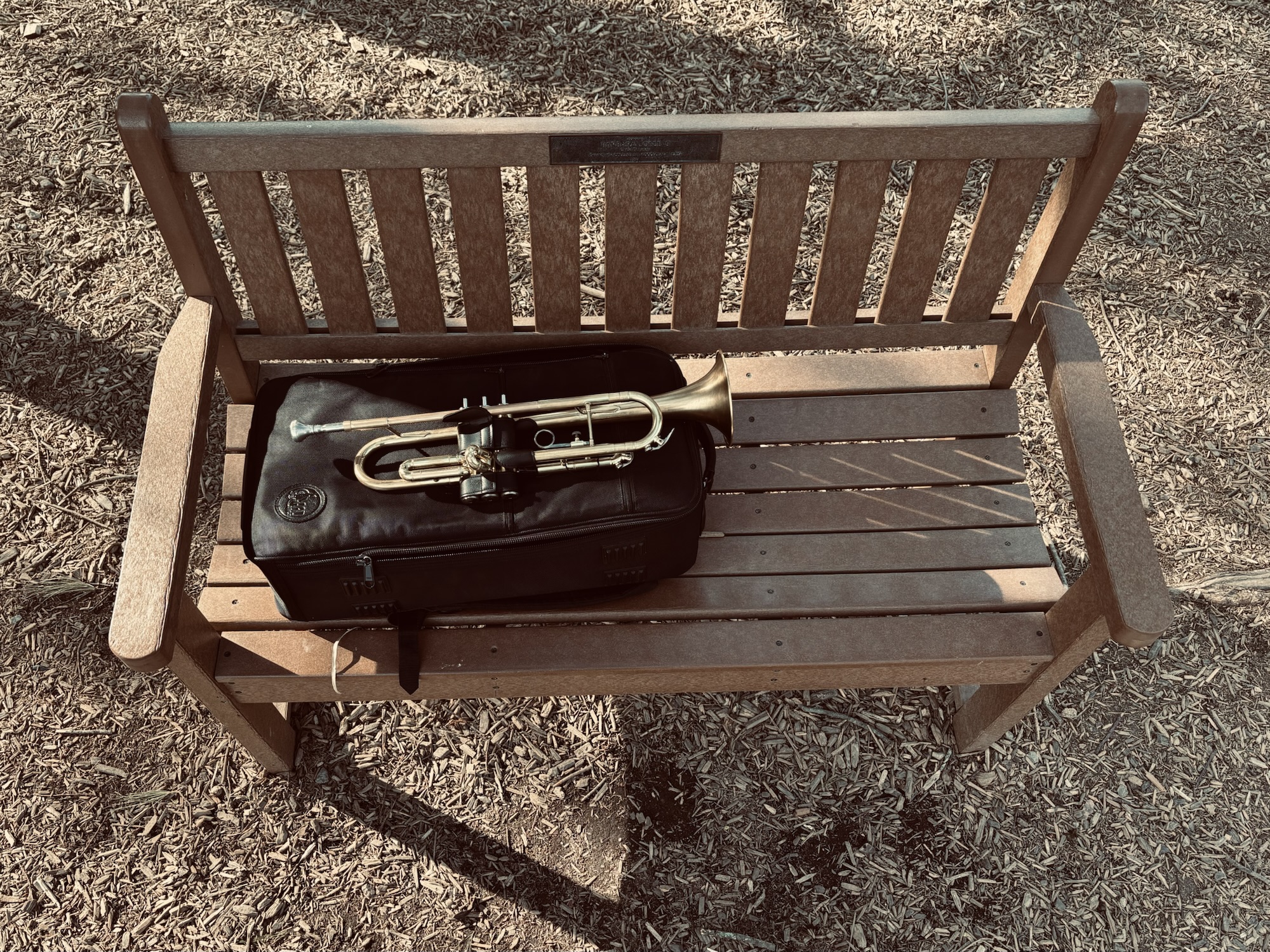
1) Practice, Practice, Practice;
2) Experiment, Research, Always Search;
3) Trumpeters don’t like studying scales. If you ask a violinist to play you scales in major, minor, diminished he’ll play them for you in the blink of an eye. Try asking a trumpeter and you’ll see. Study the scales.
4) Always practice what is worst for you, it is useless to always play what is good for you;
5) On the day you don’t study, hundreds of trumpet players are studying at that moment, and they are the ones who steal your place when you do the competitions;
6) Stamp, Schlossberg, Clarke, Caruso, Arban. Practice Caruso, create your own daily routine;
7) The study of the trumpet has equal dignity with all other disciplines; a doctor practices, a lawyer practices, an engineer practices…study and practice make the difference. We can all always improve. Don’t stop searching.
Giorgio Baggiani post 11/12/23
– Pierre Thibaud Facebook Memorial Group

“All of these amazing personalities in the music I embraced and really tried to understand the music and the feeling behind the rhythm of it all.
Because everybody has their own rhythm.
And when you can execute your own rhythm inside the harmony, with the melody, then all of a sudden you’re starting to say something, and not saying something somebody else said. You’re saying it on your own because you’re feeling it.
Creating music within the music.
You have all these spring boards along the way that happened in your development and in your personal history as an improviser and a storyteller. When you’re playing with some beautiful storytellers, that influence stays with you. It goes beyond a technical approach on your instrument.
You have your technique together. You have to get around your horn. You have to play in all 12 and you have to deal at all tempos. But then to be expressive within that is another element of storytelling.
That’s what jazz is all about; the blues, trying to tell your story within whatever the music is.
…really developing inside the music you’re playing.
The music is one thing. Now, how to create music within that music, for the moment, and have its own life; not just playing the tune.
Your sound is your approach.
And the more you can develop within the different approaches of improvising, the more you’re going to be able to say something in the music.
To be a stylist without style inside the feeling, the spirit of the music, the rhythm spirit, the harmonic and melodic spirit.
Miles Davis set the pace. And today in 2022, he is still sett’n the pace about telling a story and being yourself; and technique is about expression.
When it’s not about flying around your horn and trying to “Go for House”, which a lot of folks do… that’s easy… To say something and to play a ballad, to really be expressive in the music… Man, Miles Davis changed the world, man… You listen to him today on any of his recordings and you feel what you’re listening to.
You have to be sincere and really get deep into the feeling of the music, not just the notes. It’s how you play those notes.”
– Joe Lovano

“If you understand the cause of conflict as some fixed or one-sided idea, you can find meaning in various practices without being caught by any of them.
If you do not realize this point you will be easily caught by some particular way, and you will say, “This is excellence! This is perfect practice. This is our way. The rest of the ways are not perfect. This is the best way.” This is a big mistake.
There is no particular way in true practice. You should find your own way, and you should know what kind of practice you have right now. Knowing both the advantages and disadvantages of some special practice, you can practice that special way without danger.
But, if you have a one-sided attitude, you will ignore the disadvantage of the practice, emphasizing only its good part. Eventually you will discover the worst side of the practice, and become discouraged when it is too late.
This is silly.
So as long as you continue your practice, you are quite safe, but as it is very difficult to continue, you must find some way to encourage yourself. As it is hard to encourage yourself without becoming involved in some poor kind of practice, to continue our pure practice by yourself may be rather difficult. This is why we have a teacher.
With your teacher you will correct your practice. Of course you will have a very hard time with him, but even so, you will always be safe from wrong practice.
Most Musicians have had a difficult time with their teachers. When they talk about the difficulties, you may think that without this kind of hardship you cannot practice music. But this is not true.
Whether you have difficulties in your practice or not, as long as you continue it, you have pure practice in its true sense. Even when you are not aware of it, you have it.
So, do not think you will necessarily be aware of your own development. Whether or not you are aware of it, you have your own true development within your practice.”
– Shunryu Suzuki

“(Practice) does not have to be hard labor. Just allow your body and mind to rest…Don’t struggle.
Practice in a way that does not tire you out, but gives your body, emotions, and consciousness a chance to rest.”
– Thich Nhat Hanh

THE ORGANIZATION OF THOUGHT
Educational and Scientific
BY A. N. WHITEHEAD, Sc.D., F.R.S.
There is only one subject-matter for education, and that is Life in all its manifestations.
The mind is never passive; it is a perpetual activity, delicate, receptive, responsive to stimulus. You cannot ‘postpone its life until you have sharpened it’.
Whatever interest attaches to your subject-matter, must be evoked here and now; whatever powers you are strengthening in the pupil, must be exercised here and now; whatever possibilities of mental life your teaching should impart, must be exhibited here and now. That is the golden rule of education, and a very difficult rule to follow.
All practical teachers know that education is a patient process of the mastery of details, minute by minute, hour by hour, day by day. There is no royal road to learning through an airy path of brilliant generalizations.
We now return to my previous point, that theoretical ideas should always find important applications within the pupil’s curriculum. This is not an easy doctrine to apply, but a very hard one. It contains within itself the problem of keeping knowledge alive, of preventing it from becoming inert, which is the central problem of all education.
The best procedure will depend on several factors, none of which can be neglected, namely, the genius of the teacher, the intellectual type of the pupils, their prospects in life, the opportunities offered by the immediate surroundings of the school, and allied factors of this sort. It is for this reason that the uniform external examination is so deadly.
Choose some important applications of your theoretical subject; and study them concurrently with the systematic theoretical exposition. Keep the theoretical exposition short and simple, but let it be strict and rigid; so far as it goes. It should not be too long for it easily to be known with thoroughness and accuracy. The consequences of a plethora of half-digested theoretical knowledge are deplorable. Also the theory should not be muddled up with the practice. The child should have no doubt when it is proving and when it is utilizing. My point is that what is proved should be utilized, and that what is utilized should—so far as is practicable—be proved. I am far from asserting that proof and utilization are the same thing.
I would only remark that the understanding which we want is an understanding of an insistent present. The only use of a knowledge of the past is to equip us for the present. No more deadly harm can be done to young minds than by depreciation of the present. The present contains all that there is. It is holy ground; for it is the past, and it is the future. At the same time it must be observed that an age is no less past if it existed two hundred years ago than if it existed two thousand years ago.